
Dr Lisa Whalley
lisa.whalley@ncas.ac.uk
0113 343 6594
Enquire for details.
Calendar
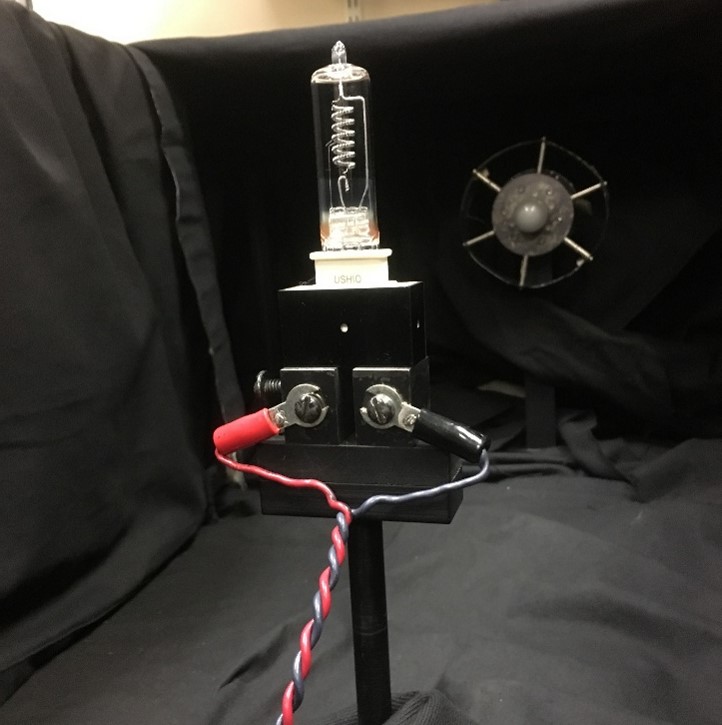
Community calibration facility for spectral radiometers used for actinic flux and photolysis rate measurements
As of April 2026, this Lab can no longer be accessed through applications to AMOF. However, it remains available to the community through the University of Leeds. Contact Dr Lisa Whalley for further details.
The spectral radiometer calibration facility is located in the School of Chemistry at the University of Leeds. We offer the following services:
Determination of the absolute sensitivity of spectral radiometers:
- Calibrations are performed using a NIST-traceable spectral irradiance standard (OL-FEL-A, 1kW, calibrated between 250 – 750 nm) and stabilised current source (OL 83A). The lamp and receiver optics are mounted on an optical bench at a lamp-specified distance. During calibrations, the lamp and receiver are enclosed in a black box to eliminate reflections from surfaces. A filter holder which can house cutoff filters can be placed between the lamp and receiver, e.g. a WG320 long-pass filter, which removes radiation below 320 nm, for stray-light assessment.
Verify wavelength accuracy of spectral radiometers:
- Using a low-pressure mercury pen-ray lamp, literature Hg emission lines, in the range of 290 – 550 nm, can be compared to instrument spectra to determine any wavelength offsets.
Determination of the absolute sensitivity of spectral radiometers:
- Calibrations are performed using a NIST-traceable spectral irradiance standard (OL-FEL-A, 1kW, calibrated between 250 – 750 nm) and stabilised current source (OL 83A). The lamp and receiver optics are mounted on an optical bench at a lamp-specified distance. During calibrations, the lamp and receiver are enclosed in a black box to eliminate reflections from surfaces. A filter holder which can house cutoff filters can be placed between the lamp and receiver, e.g. a WG320 long-pass filter, which removes radiation below 320 nm, for stray-light assessment.
Verify wavelength accuracy of spectral radiometers:
- Using a low-pressure mercury pen-ray lamp, literature Hg emission lines, in the range of 290 – 550 nm, can be compared to instrument spectra to determine any wavelength offsets.
Not applicable.
Instruments should be sent to the lab for calibration.
Calibration performed by Facility staff
All instrumentation sent to the facility should have an up-to-date electrical safety test (PAT label)
Any user-owned instruments needing delivery should be shipped to the following address
School of Chemistry
University of Leeds
Woodhouse Lane
Leeds
LS2 9JT
UK
Mark all items for the attention of Dr Lisa Whalley
Consumables
- If bringing in additional instrumentation then all consumables and tools for that instrumentation should be provided.
Costs
- Instrument Insurance
- The user must have comprehensive insurance for any kit they bring
- Public Liability Insurance
- AMOF is not liable for any damage or injury arising from the deployment or operation of this instrument when unattended by the instrument scientists.
Shipping
- The user is liable for all costs arising from the shipping of any instruments both to and from the School of Chemistry.