
Cylinder Filling Facility (CFF)
Services
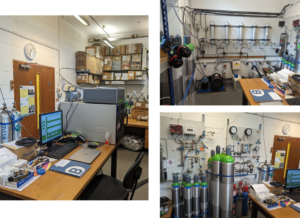
The Cylinder Filling Facility (CFF) is a bespoke system built at the UEA and consists of three main components: a gas compressor, capable of filling gas cylinders to 300 bar; a scrubbing panel to lower the amount fraction of a constituent and dry the incoming air; and a spiking’ panel to raise the amount fraction of a constituent above the ambient concentrations.
Ambient air is drawn from the roof of the building at UEA using an air compressor and sent to a gas cylinder at high pressure. While passing from the compressor to the gas cylinder, the composition of the ambient air can be tailored by removing a fraction of a particular gas using the scrubbing panel. Gas mixtures containing higher than ambient mole fractions are made by adding a known amount of highly concentrated gas to the empty cylinder via the spiking panel before filling. To maintain the stability of the gas mixture, all compressed gas mixtures made in the CFF are dried and contain only trace amounts of water vapour.
The facility can fill a wide range of gas cylinder types depending on the user’s requirements. For example, the requirements of a cylinder to be used on the FAAM aircraft are different from those needed for long-term measurements. For GHGs, such as carbon dioxide or methane, the concentration in the gas mixture during the filling process can be monitored while filling.
It is important to note that the CFF does not produce ‘certified’ GHG standards. The concentrations of GHGs in a gas mixture can only be certified to WMO scales at NOAA or a WMO-assigned CCL; the CCL for Europe is the Swiss Federal Laboratories for Materials Science and Technology (EMPA). Therefore, gases made in the UEA CFF should be considered as working gas mixtures that have been accurately measured alongside NOAA primary gases. Through the UK GEMMA programme, we are exploring potential routes for the UEA facility to become a CCL for GHGs. Currently, when a certified GHG standard is needed (e.g., UK Tall Tower GHG validation network), we are happy to facilitate their measurement at EMPA through our historical working relationship. However, it is important to note that EMPA cannot make high-pressure compressed gas mixtures.
Equipment:
• Picarro G2301 analyser for carbon dioxide (CO2), methane (CH4) and water vapour
• Los Gatos analyser for nitrous oxide (N2O), carbon monoxide (CO) and water vapour
• Primary calibration gases(x8) from NOAA calibrated on the WMO scales for CO2, CH4, N2O and CO
• Rix compressor x 2
• Gas scrubbing manifold
• Gas spiking manifold
• Pure gases for spiking
• Dew point meter
• Zero Air Generator
• Bespoke software for assigning the concentration of GHGs against NOAA primary gases.
• Bespoke cylinder tracking software.
In addition to filling gas cylinders for GHG research, the CFF offers the following services.
• Other gases: We can adjust and measure the concentrations of other trace gas species, including oxygen, hydrogen and ethane.
• Gas cylinder conditioning: We routinely condition all gas cylinders before filling. This process involves evacuating a cylinder over several days to reduce the amount of residual water vapour present on its internal surface. We can offer this service separately, as some studies require empty cylinders to be sent to remote locations and filled in situ.
• Coordination of certification: After producing the gas mixture in the CFF, we can arrange for cylinders to be officially certified at EMPA. This has been standard practice for gas mixtures used on the FAAM aircraft for several years.
All new cylinders are inspected internally for any imperfections prior to valving as any imperfections can lead to instability of the gas mixture. Because of this we have stablished protocols to valve cylinders in the CFF.
For further details please contact Dr Nicholas Garrard: nicholas.garrard@ncas.ac.uk